Aura by Method
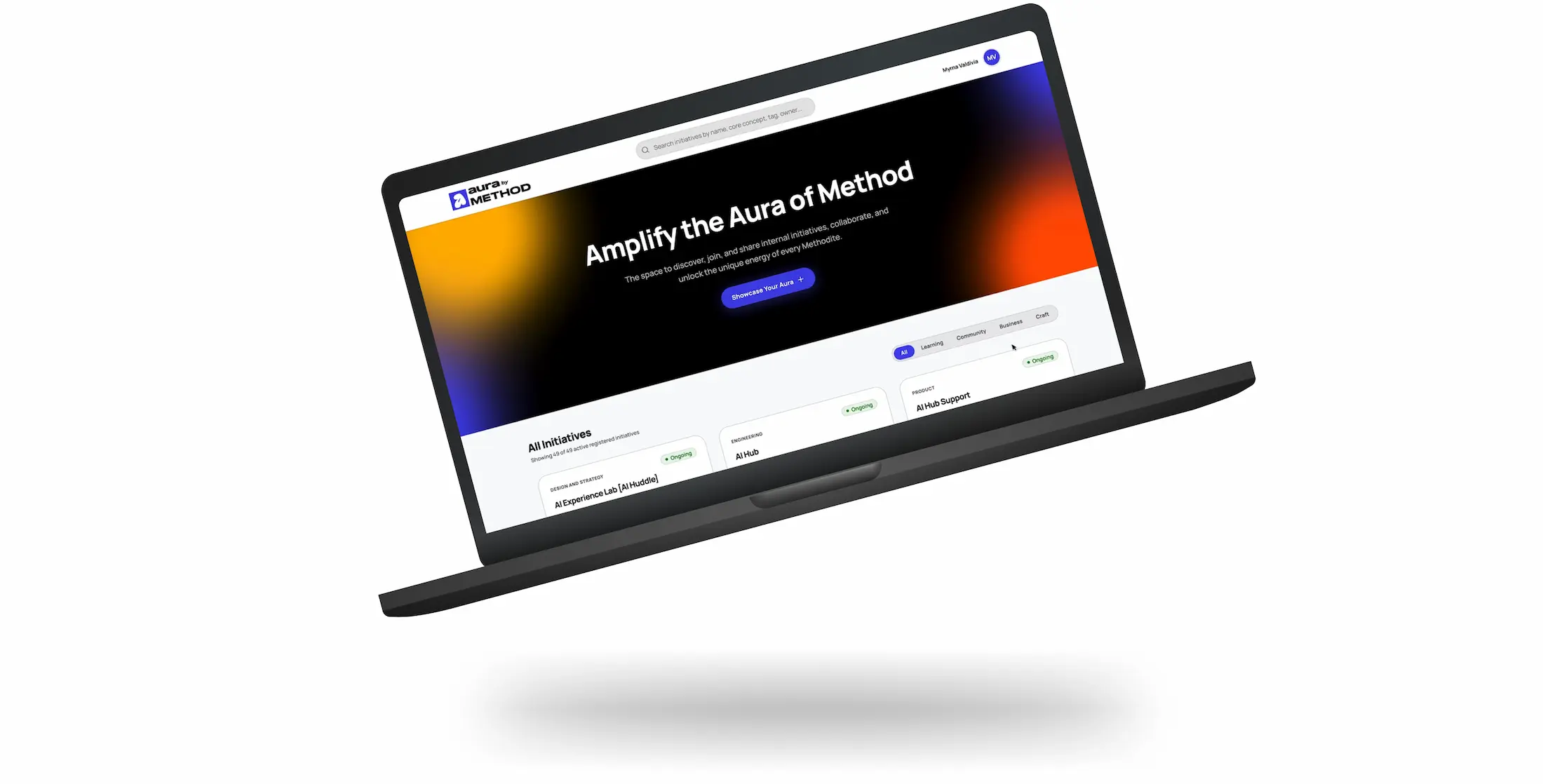
The product: A digital platform built for Method employees to visualize and discover company initiatives,and easily connect with colleagues to collaborate on new projects.
Challenge: Reimagine how employees discover, engage with, and contribute to internal initiatives by transforming fragmented information into a scalable, human-centered MVP.
Project duration: 2 months.
Deliverables: Research, Wireframes, Prototypes and UI.
Role: Product Designer.
The Problem
Method invests real time and money into internal initiatives but they face three critical barriers that hinder their impact:
Fragmentation:
Initiatives documentation is inconsistent, making it difficult for employees to know where to find information about them.
What's in it for me? (WIIFM?):
We lack a dynamic tool that clearly communicates the real value of investing time.
Lack of Cross-Departments Visibility:
Without a hub for initiatives, departments and teams risk working on the exact same things without knowing it.
Who are we designing for?
Early in the project, it became clear that information fragmentation was a universal pain point affecting the entire organization. However, while the root problem was the same, its impact was felt differently across roles:
-
Employees: With limited free time, they want to instantly understand the mutual value: what the initiative offers them and how they can contribute in return.
-
Stakeholders: Their WIIFM revolves around avoiding duplicated cross-departmental work.
-
Client: Their goal is to deliver a dynamic platform that effectively aligns the employees' need for growth with the stakeholders' need for efficiency.
The Design Framework
This is the path we followed to find a solution:

Discovery & Research
Users Mapping
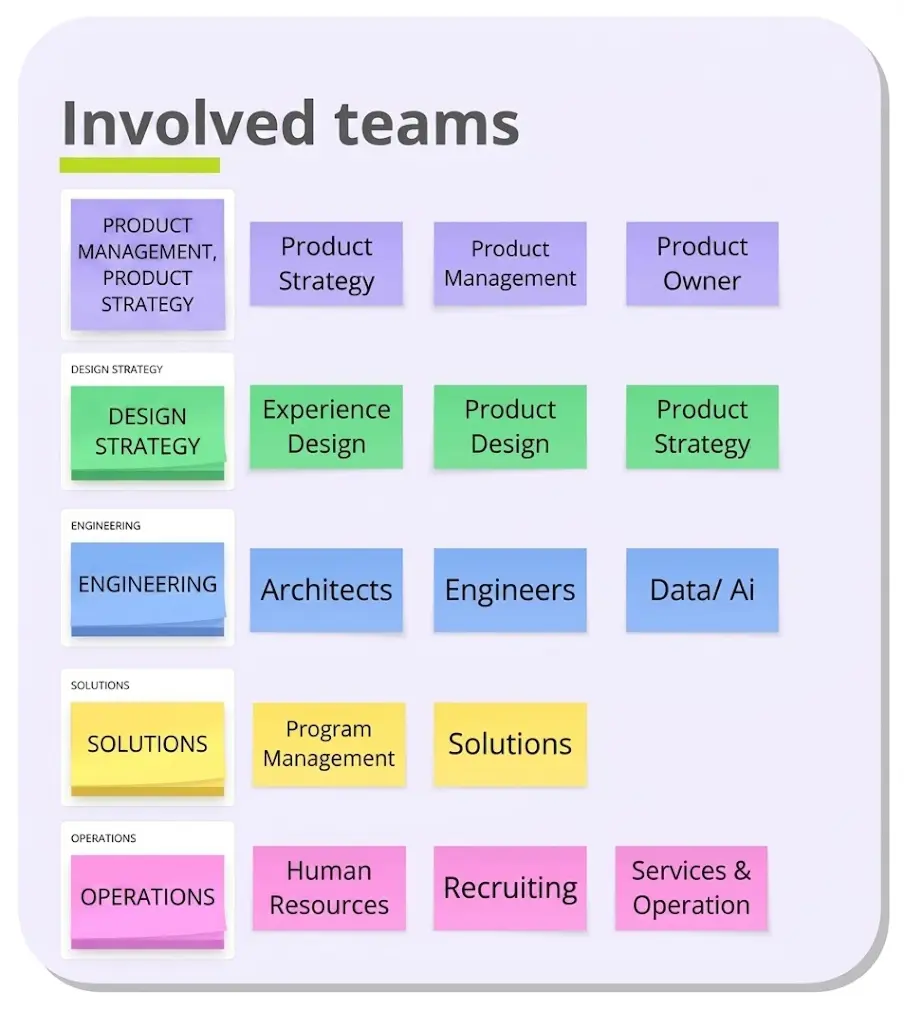
We created a stakeholder map that encompassed five different departments across the company. To ensure our subsequent research was holistic, it was paramount to strategically select at least one interviewee from each department.
User Interviews
The objective was to understand how different employee profiles at Method discover and access internal initiatives, what pain points they encounter, and what leads them to participate.

Initiatives Mapping
In parallel with identifying our interviewees, we conducted a comprehensive audit to map all existing initiatives in a spreadsheet. We established a standardized taxonomy to collect and display initiative information.
💡 As a Product Designer, defining the taxonomy was a critical step. It directly dictated the Information Architecture and how the content would be visually structured and displayed in the final prototype.
Ideation
To move from insights to solutions, I conducted ideation and prioritization exercises like HMW?, Crazy 8s, and MoSCoW. I also used Figma to visualize these solutions and iterate quickly on the product when needed.


The Product Scope
Defining the scope was crucial to establish the MVP: delivering the essential features needed to solve fragmentation, ensure visibility, and answer the core question of "What's in it for me?”
The Proof of Concept
I created a functional prototype utilizing real data to create a two-way sync between the data source and the interface.
Design & Prototype
I defined three main flows: from wireframes to an interactive prototype in AI Studio.
Handoff Ready
I aligned with developers to establish a GitHub repository, ensuring the code and prototype remain scalable.
High-Fidelity Prototype
Based on the defined product scope, this high-fidelity prototype now allows users to easily discover different initiatives through categories and understand what each one offers at a single glance.
*This prototype contains confidential data.
Design Choices


Adhering to Method's design guidelines was fundamental to ensure Aura feels daily workflow, rather than an isolated tool.
Product Summary
In the MVP:
-
Users now can discover initiatives in a standardized way.
-
Users now can register initiatives.
-
Users can now edit initiatives.
-
The product is a working code prototype aligned to the company’s Method design guideline.
Pending Tasks:
-
Backend Integration: Transitioning from POC to a live database and activating the Slack API.
-
Access must be limited to verified through a Single Sign-On (SSO) integration using their corporate email credentials.
-
A usability study.
Peer Reviews
Sharing my progress and iterations openly allowed me to grow as a designer. Here is some of the incredible peer validation the project received along the way:
"You really owned the prototyping stage (...) Thank you for your work, adaptability, and leadership across this initiative"
Program Manager
"Don’t thank me, you did great progress in just 8 weeks"
Engineer
"Amazing job with the presentation!!! (...) it was clear that you deeply care and believe in Aura"
Product Designer
Learnings 🌱
Navigating this project taught me that defining the scope is a Product Designer's superpower. With a tight timeline, I learned to prioritize core functionalities that delivered immediate value. Leveraging AI allowed me to iterate faster on my designs, and rather than feeling intimidated by it, I walked away feeling more prepared.